Recent Project in the Distillery District
Floor tile preparation in the Distillery District: thinset combed out with a notched trowel ahead of the floor tile, with large stone-look tile already set on the wall beside it.
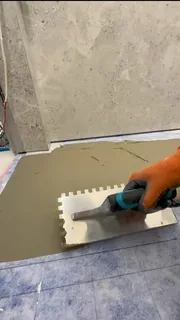
Floor tile preparation in the Distillery District: thinset combed out with a notched trowel ahead of the floor tile, with large stone-look tile already set on the wall beside it.
A brick-and-beam unit here is the most characterful space in the city to put a floor into and one of the least cooperative to work on. The slab is thick and strong but was poured for machinery, so it carries falls, patches and surface treatments that have to be identified before an adhesive is chosen. Levelling is a normal line rather than an exception. Heritage buildings also transmit impact noise differently to purpose-built residential concrete, which is why declarations in converted stock sometimes set a higher acoustic minimum than a new tower would. The compensation is that these floors take a coated or polished finish beautifully, if you want the concrete itself to be the floor.
Levelled and primed original slabs under engineered, plank or tile.
Epoxy at $7 to $14 per square foot where the slab should stay the floor.
Acoustic underlay with its lab certificate, for a converted building's declaration.
Hardeners, sealers and decades of industrial residue affect every adhesive decision.
Industrial slabs were not poured to a flooring tolerance and rarely meet one now.
Converted buildings sometimes require more than a new tower, not less.
Where the slab has character worth keeping, a coating is often a better answer than covering it.
The reason to live in a brick-and-beam unit is the fabric of the building, and a floor can either sit comfortably against that or fight it. Wide boards and a matte finish read as belonging. High-gloss and narrow strip read as new material dropped into an old room. Where the slab itself has the wear and patching that gives these buildings their character, a clear coating that leaves it visible is often a better answer than covering it up.
Reviews collected directly from clients.
We chose Ontario Flooring for luxury vinyl plank installation in our basement. They prepared the subfloor properly, explained the process clearly, and delivered an even, durable finish.
We had several damaged floorboards that needed repair. The team matched the new boards closely with the existing flooring and completed the work with excellent attention to detail.
Often yes, and it suits these units. A coating at $7 to $14 per square foot gives a durable, sealed surface while leaving the slab's history visible. It needs diamond grinding first and it will not hide every patch, which for most people here is the point.
Because the concrete was poured for machinery, with falls for drainage and patches where equipment was removed. That is well outside the 3/16 of an inch over 10 feet a floating floor needs, so the compound goes down first.
Heritage designation governs the exterior and the building fabric rather than your interior finish floor, so it rarely affects the flooring itself. Your condo declaration is the document that governs your floor, and that is the one to read.