Recent Project in Kensington Market
Tile installation in Kensington Market, with a laser level projecting the layout line across the room and thinset combed with a notched trowel before the next tiles go down along that line.
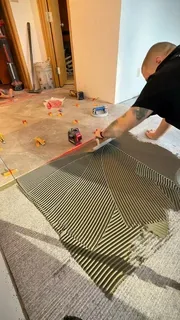
Tile installation in Kensington Market, with a laser level projecting the layout line across the room and thinset combed with a notched trowel before the next tiles go down along that line.
The rowhouses here predate almost everything else in the flooring conversation. The subfloor is frequently diagonal plank rather than sheet panel, which does not hold a modern cleat the way nail-down hardwood expects, and it is usually thinner than the 19 mm panel we want under nail-down hardwood. That means a plywood overlay at $2 to $3 per square foot on most new-floor jobs. The upside is what is already there: original softwood or early oak boards that have survived a century and, in many cases, still have enough thickness above the tongue to sand. Refinishing at $4 to $8 per square foot beats replacing at $10 to $18, and in a house of this age it is the better outcome anyway.
Sanded back and re-coated where there is wear layer left to work with.
Plywood over original plank where new hardwood is going down.
Individual boards matched and cut in rather than replacing a whole floor.
Common in this era, and not what modern nail-down hardwood is designed to fasten into.
Below 19 mm an overlay is needed before hardwood, which raises the floor and changes door clearances.
A century-old floor may have had two or three sandings. We check the board edge before promising another.
Narrow frontages, shared walls and a street that is busy all day. Deliveries and waste removal are planned rather than assumed.
A century of settlement and a shared party wall mean the rooms here have no parallel lines to work from. Laying a floor square to one wall leaves a visible taper against the opposite one. The layout gets set out from whatever line the eye actually reads, usually the longest sightline or the threshold you walk through, and the taper gets pushed to where a piece of furniture or a shadow line hides it. It is slower to set out and it is what makes an old room look right.
Reviews collected directly from clients.
The team refinished our existing hardwood floors and brought them back to life. The colour looks great, and the final finish is smooth and consistent.
We had several damaged floorboards that needed repair. The team matched the new boards closely with the existing flooring and completed the work with excellent attention to detail.
Often yes, and it is the first thing we check. Lift a threshold or pull a vent and look at the board edge. If there is meaningful thickness above the tongue, it will take another sand. If the tongue is close to the surface or nails are showing, it will not, and forcing it ruins the floor.
Usually not directly. Diagonal plank moves independently and is often under the 19 mm minimum, so a plywood overlay goes down first. It is a line on the quote rather than a reason to avoid hardwood.
That is the question an overlay raises. Adding plywood plus a finished floor gains real height, so doors get undercut and stair nosings adjusted. It is normal work and it is better planned than discovered.